2012 Tucson Festival of Books: "America at War"
To be aired Monday, April 9, at 2:00 a.m. ET
About the Program
From the 2012 Tucson Festival of Books, a panel discussion entitled, "America at War." The panelists include, William Inboden, Religion and American Foreign Policy, 1945-1960, Mary Dudziak, War Time: An Idea, Its History, Its Consequences, and Andrei Cherny, The Candy Bombers: The Untold Story of the Berlin Airlift and America's Finest Hour. The panel is moderated by Sam Kleiner, MPhil Candidate in International Studies, St. Anthony's College.
About the Authors
William Inboden is an assistant professor of public affairs at the LBJ School of Public Affairs and distinguished scholar at the Strauss Center for International Security and Law, University of Texas at Austin. He formerly served during the Bush administration as senior director for strategic planning on the National Security Council at the White House.
Buy the author's book from: Amazon | Barnes & Noble | Indiebound
Mary Dudziak is the author of several books, including Exporting American Dreams: Thurgood Marshall's African Journey. She is a law, history and political science professor at the University of Southern California Gould School of Law. For more information, visit mdudziak.com.
Buy the author's book from: Amazon | Barnes & Noble | Indiebound
Andrei Cherny is a former speechwriter and advisor to Vice President Al Gore. He is the author of The Next Deal: The Future of Public Life in the Information Age. Mr. Cherny is the former Arizona Democratic Party Chairman and is running for Congress to represent Arizona's 9th District.
Buy the author's book from: Amazon | Barnes & Noble | Indiebound
Wednesday, April 4, 2012


Thursday, March 29, 2012
On Fairness Radio 3/29
I'll be talking about War Time on FAIRNESS RADIO with Patrick O'Heffernan and Chuck Morse on Thursday, March 29, 1:15-1:45 Eastern time.
Thursday, March 22, 2012
Wisconsin Public Radio Today
I'll discuss War Time this afternoon on Wisconsin Public Radio, airing at 5:00 to 6:00 p.m. Central Time, 3:00 pm Pacific Time. You can listen live here.
Wednesday, March 14, 2012
Scholar's Circle discusses War Time on Pacifica Radio
Updated:
War Time will be the focus of a radio panel discussion with Patrick James, Center for International Studies, University of Southern California, Christoper Nichols, Department of History, University of Pennsylvania, and me. It will be broadcast on KPFK, 90.7 in Los Angeles, airing just before 12:30 pm on Sunday, March 18. I'll post a podcast link when it is available.
War Time will be the focus of a radio panel discussion with Patrick James, Center for International Studies, University of Southern California, Christoper Nichols, Department of History, University of Pennsylvania, and me. It will be broadcast on KPFK, 90.7 in Los Angeles, airing just before 12:30 pm on Sunday, March 18. I'll post a podcast link when it is available.
Friday, March 9, 2012
America at War: 21st Century Struggles -- at the Tucson Book Festival and on C-Span2
C-Span2 will have live streaming of this panel on Sunday, 1 pm Arizona time/4 pm Eastern time, at the Tucson Festival of the Book:
"America at War: 21st Century Struggles"
William Inboden, Religion and American Foreign Policy, 1945-1960
Mary Dudziak, War Time: An Idea, Its History, Its Consequences
Andrei Cherny, The Candy Bombers: The Untold Story of the Berlin Airlift and America's Finest Hour
Tuesday, March 6, 2012
Monday, February 27, 2012
On WAMC's Roundtable Today
I'm discussing War Time on Northeast Public Radio/WAMC’s Roundtable, this morning,11:10-11:25 Eastern.
Wednesday, February 22, 2012
Public Radio Interview
KERA Radio (North Texas/Dallas Fort Worth), Thursday, February 23:
How are wars that never really end changing our concept of what “being at war” means? We’ll talk this hour with Mary L. Dudziak, the Judge Edward J. and Ruey L. Guirado Professor of Law, History and Political Science at the University of Southern California Law School. Her new book is “War Time: An Idea, Its History, Its Consequences” (Oxford University Press, 2012).Listen here.
Monday, February 20, 2012
Bacevich on The War Formerly Known as the Global War on Terrorism
Andrew Bacevich,one of the most important and prolific critics of current American military policy, has a post today on the nature of the current war era at TomDispatch and HNN:
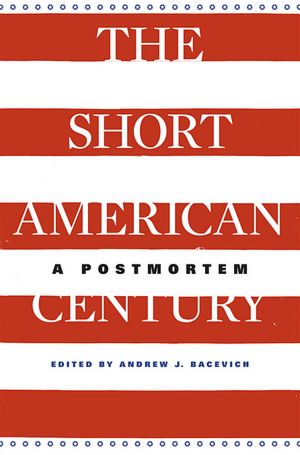
Continue reading here. Bacevich's newest book is an edited collection The Short American Century: A Postmortem. Cross-posted at Balkinization.With the United States now well into the second decade of what the Pentagon has styled an “era of persistent conflict,” the war formerly known as the global war on terrorism (unofficial acronym WFKATGWOT) appears increasingly fragmented and diffuse. Without achieving victory, yet unwilling to acknowledge failure, the United States military has withdrawn from Iraq. It is trying to leave Afghanistan, where events seem equally unlikely to yield a happy outcome.
Elsewhere—in Pakistan, Libya, Yemen, and Somalia, for example—U.S. forces are busily opening up new fronts. Published reports that the United States is establishing “a constellation of secret drone bases” in or near the Horn of Africa and the Arabian Peninsula suggest that the scope of operations will only widen further. In a front-page story, the New York Times described plans for “thickening” the global presence of U.S. special operations forces. Rushed Navy plans to convert an aging amphibious landing ship into an “afloat forward staging base”—a mobile launch platform for either commando raids or minesweeping operations in the Persian Gulf—only reinforces the point. Yet as some fronts close down and others open up, the war’s narrative has become increasingly difficult to discern. How much farther until we reach the WFKATGWOT’s equivalent of Berlin? What exactly is the WFKATGWOT’s equivalent of Berlin? In fact, is there a storyline here at all?
Sunday, February 19, 2012
TODAY: Book Talk at Politics and Prose, Feb. 19
Moved to the top of the blog:
I'm speaking about War ∙ Time at Politics and Prose Bookstore in Washington, D.C., on Sunday, February 19, at 5:00 p.m. Here are the details:
 Mary Dudziak - War ∙ Time
Feb 19 2012, 5:00 pm
Politics and Prose
5015 Connecticut Ave NW
Washington, D.C. 20008United States
“Wartime” was once considered exceptional—an interruption to the norm that was peacetime. But as Dudziak, USC professor of law, history, and political science, observes in her thought-provoking study, the U.S. has been involved continuously in various overseas armed conflicts for the past century. Given this new, never-ending nature of war, what are the implications for law, politics, and culture?
All our in-store events are free and open to the public. All event titles are 20% off for members during the month in which the author appears at the store. Click here for directions. There is ample parking available in the lot behind the store and in the surrounding neighborhood.
More details are here.
I'm speaking about War ∙ Time at Politics and Prose Bookstore in Washington, D.C., on Sunday, February 19, at 5:00 p.m. Here are the details:

Feb 19 2012, 5:00 pm
Politics and Prose
5015 Connecticut Ave NW
Washington, D.C. 20008United States
“Wartime” was once considered exceptional—an interruption to the norm that was peacetime. But as Dudziak, USC professor of law, history, and political science, observes in her thought-provoking study, the U.S. has been involved continuously in various overseas armed conflicts for the past century. Given this new, never-ending nature of war, what are the implications for law, politics, and culture?
All our in-store events are free and open to the public. All event titles are 20% off for members during the month in which the author appears at the store. Click here for directions. There is ample parking available in the lot behind the store and in the surrounding neighborhood.
More details are here.
Friday, February 17, 2012
How Presidential War Power is Made, or why rhetoric matters to war powers
Over at Lawfare, Benjamin Wittes found my op-ed in yesterday’s New York Times, on Obama’s double-take on the nature of our current war era, to be “perplexing.” Let me say a few words that are unlikely to lead Wittes and me to agree on everything, but at least might help crystalize what the disagreement is about. I should also say that I tend to agree with one of the underlying ideas at Lawfare, as I understand their project, and that Mark Tushnet has also made: “liberals” and “conservatives” are often talking past each other on questions of national security, and there is a need to reshift the conversation, and get beyond partisan and left/right divides.
The most essential point is methodological (and if you’re looking for the direct points about my op-ed/Wittes’ post, skip ahead a couple of paragraphs). As legal scholars we tend to focus especially on law, of course. Law and society scholars, including legal historians like me, study law by going beyond it – by studying law in a broader historical and cultural context. Law exists as part of and in relation to society and culture, so that we can’t fully see law without understanding the way it is produced and understood – socially, politically, culturally.
Like other legal problems, law related to war and security is a law-and-society subject. Many very smart war powers and national security law specialists have been drilling down on the complex legal issues related to the post-9/11 context, an effort that Lawfare contributes to. But as with all legal issues, there is also a law-and-society component. Although war powers and national security scholarship often draws upon historical examples, the scholarship does not tend to incorporate current important work by historians and others related to war and security. So, in my view, the law-and-society aspect of legal war and security studies is underdeveloped. Alongside of the current focus on national security law in American law schools, we need, essentially, law-and-society law & security.
How does that relate to my op-ed? My piece is about Obama’s political rhetoric related to war, and I argue that he is trying to have it both ways. As a political matter, he has focused on the wars in Iraq and Afghanistan. His campaign promise was to bring these wars to an end. Early in his administration he would say “we’re in two wars.” But in 2010 he shifted, and gave a speech that said the nation is “at war with Al Qaeda.”
This shift in political rhetoric enables the president to argue that he is filling his campaign promise of ending the wars that he was talking about when he got elected, but at the same time the new formulation maintains (politically) the basis for his war-related powers.
Now for the law-and-society point: presidential war powers are determined not only by legal authorities and constraints, to the extent they exist, and by capacities inherent in the executive branch. As Scott Silliman put it in a national security law class at Duke last semester, the president “paints the scene.” Important work by historians helps to fill in the way presidents essentially narrate wars for the American public (my formulation, not Silliman’s), helping to generate both political sentiment and also, most simply, the conception that something happening faraway is a “war” that the security of Americans at home hinges upon. (This is not a post-9/11 problem, but was a critical Cold War issue, and also was important in earlier years.) Political scientist Adam Berinsky helps us to see that what Americans “know” about overseas conflict does not derive directly from the conflict itself, but is filtered in the same way as public opinion on other matters: it is affected by elite discourse and partisan politics.
This is a long way of saying that presidential rhetoric on war and security is tremendously important and consequential. I focused only on Obama’s flip: “Ending major conflicts in two countries helps him deliver on campaign promises. But his expansive definition of war leaves in place the executive power to detain without charges, and to exercise war powers in any region where Al Qaeda has a presence.” But the ultimate problem goes beyond what looks like a political bait-and-switch. By narrating war differently, Obama is “painting the scene” differently, in a way that will not determine the scope of his war-related powers down the road, including but not limited to detention. Though not determinative, a president’s framing of a war era is a first and essential component of the generation and maintenance of presidential war powers.
I take up Wittes directly, and the ways we’re talking past each other, below the fold.
The most essential point is methodological (and if you’re looking for the direct points about my op-ed/Wittes’ post, skip ahead a couple of paragraphs). As legal scholars we tend to focus especially on law, of course. Law and society scholars, including legal historians like me, study law by going beyond it – by studying law in a broader historical and cultural context. Law exists as part of and in relation to society and culture, so that we can’t fully see law without understanding the way it is produced and understood – socially, politically, culturally.
Like other legal problems, law related to war and security is a law-and-society subject. Many very smart war powers and national security law specialists have been drilling down on the complex legal issues related to the post-9/11 context, an effort that Lawfare contributes to. But as with all legal issues, there is also a law-and-society component. Although war powers and national security scholarship often draws upon historical examples, the scholarship does not tend to incorporate current important work by historians and others related to war and security. So, in my view, the law-and-society aspect of legal war and security studies is underdeveloped. Alongside of the current focus on national security law in American law schools, we need, essentially, law-and-society law & security.
How does that relate to my op-ed? My piece is about Obama’s political rhetoric related to war, and I argue that he is trying to have it both ways. As a political matter, he has focused on the wars in Iraq and Afghanistan. His campaign promise was to bring these wars to an end. Early in his administration he would say “we’re in two wars.” But in 2010 he shifted, and gave a speech that said the nation is “at war with Al Qaeda.”
This shift in political rhetoric enables the president to argue that he is filling his campaign promise of ending the wars that he was talking about when he got elected, but at the same time the new formulation maintains (politically) the basis for his war-related powers.
Now for the law-and-society point: presidential war powers are determined not only by legal authorities and constraints, to the extent they exist, and by capacities inherent in the executive branch. As Scott Silliman put it in a national security law class at Duke last semester, the president “paints the scene.” Important work by historians helps to fill in the way presidents essentially narrate wars for the American public (my formulation, not Silliman’s), helping to generate both political sentiment and also, most simply, the conception that something happening faraway is a “war” that the security of Americans at home hinges upon. (This is not a post-9/11 problem, but was a critical Cold War issue, and also was important in earlier years.) Political scientist Adam Berinsky helps us to see that what Americans “know” about overseas conflict does not derive directly from the conflict itself, but is filtered in the same way as public opinion on other matters: it is affected by elite discourse and partisan politics.
This is a long way of saying that presidential rhetoric on war and security is tremendously important and consequential. I focused only on Obama’s flip: “Ending major conflicts in two countries helps him deliver on campaign promises. But his expansive definition of war leaves in place the executive power to detain without charges, and to exercise war powers in any region where Al Qaeda has a presence.” But the ultimate problem goes beyond what looks like a political bait-and-switch. By narrating war differently, Obama is “painting the scene” differently, in a way that will not determine the scope of his war-related powers down the road, including but not limited to detention. Though not determinative, a president’s framing of a war era is a first and essential component of the generation and maintenance of presidential war powers.
I take up Wittes directly, and the ways we’re talking past each other, below the fold.
Wednesday, February 15, 2012
If we're ending a war, what war are we ending?
If the combat mission in Afghanistan ends next year, does that have an impact on the president's war powers? I take this up in the New York Times:
Continue reading here. Cross-posted at Balkinization.THE defense secretary, Leon Panetta, recently announced that America hoped to end its combat mission in Afghanistan in 2013 as it did in Iraq last year. Yet at Guantánamo Bay and elsewhere, the United States continues to hold enemy detainees “for the duration of hostilities.”
Indeed, the “ending” of combat in Afghanistan and Iraq appears to have no consequences for the ending of detention. Because the end of a war is traditionally thought to be the moment when a president’s war powers begin to ebb, bringing combat to a close in Afghanistan and Iraq should lead to a reduction in executive power — including the legitimate basis for detaining the enemy.But there is a disconnect today between the wars that are ending and the “war” that is used to justify ongoing detention of prisoners.
Sunday, February 12, 2012
War Time Interview Podcast
You can listen to my conversation with Ian Masters at KPFK Radio right here. Scroll forward. Our discussion comes about 15 minutes into the hour, and continues for about 45 minutes.
New on-air time today
My appearance on KPFK Radio has been moved up. You can listen live from about 11:15 am Pacific Time on.
Saturday, February 11, 2012
On the radio...
You can listen in at KPFK Radio this Sunday at noon, Pacific Time. The station is having a fund drive, and during the broadcast you can even make a pledge and get a copy of my book!
Thursday, February 9, 2012
Banks on "Shadow Wars"
William C. Banks, Syracuse University, has a short essay in the Journal of National Security Law and Policy on "Shadow Wars." "In the post-9/11 environment," he writes,
the United States confronted the Taliban, al Qaeda, and associated terrorist and insurgent groups, where the conventional military force that quickly forced Iraq’s retreat from Kuwait and subdued the Milosevic regime in Kosovo in the 1990s was far less effective. Paramilitary campaigns waged by the CIA and contractors became an integral part of the counterterrorism response to these new enemies, and our military greatly expanded its own capabilities to collect intelligence and carry out clandestine operations. Over time, first in the Bush administration and now in an expanded and more aggressive strategy by the Obama administration, the United States has been conducting what The New York Times described as a “shadow war against Al Qaeda and its allies”:The essay introduces a special issue of the Journal (currently on the website's first page), guest edited by constitutional war powers scholar Louis Fisher. Banks' compelling essay concludes by arguing that these covert actions "reach almost every corner of the globe," and call for scholarly attention.
In roughly a dozen countries – from the deserts of North Africa, to the mountains of Pakistan, to former Soviet republics crippled by ethnic and religious strife – the United States has significantly increased military and intelligence operations, pursuing the enemy using robotic drones and commando teams, paying contractors to spy and training local operatives to chase terrorists.
Bookforum Review
Charles Homans, a New Republic writer, reviews War Time in the current issue of Bookforum. Not accessible on-line unfortunately. I'll link to a pdf soon.
Tuesday, February 7, 2012
Monday, February 6, 2012
How the Cold War Matters to the War Powers Debate
This is the second in a series of posts about my new book, War·Time: An Idea, Its History, Its Consequences, kicked off when Eric Posner so helpfully generated an on-line discussion. He dismisses an argument about Cold War statebuilding because "it would be hard to exaggerate legal scholars’ obsession with the rise of executive power, going back at least to the Nixon administration, indeed to the New Deal."
The question of why the Cold War matters to an understanding of the war powers debate might, at first glance, seem obvious. The most iconic case about presidential war power, Youngstown Sheet & Tube v. Sawyer (1952), is a product of the Cold War era, decided during the Korean War. We might also think of the Cold War as one “wartime” among many in American history, so that we might compare this wartime to others when analyzing the role of the courts in reining in executive power. It’s especially when this sort of argument is employed that the Cold War presents some difficulty. The Cold War is ambiguous, on its own terms. Was it really a “wartime” that we can compare with others, or was it something else?
The problem of just what the Cold War was was anticipated by George Orwell in 1945. When reflecting on what the advent of nuclear weapons would bring, Orwell suggested that the world would be divided between two or three “monstrous super-states,” each with nuclear weapons, that would “divid[e] the world between them.” These monster states would not use the bomb against each other. Instead, they would be “unconquerable and in a permanent state of ‘cold war’” with their neighbors. The nuclear age would therefore bring “an end to large-scale wars at the cost of prolonging indefinitely ‘a peace that is no peace.’” The idea that the Cold War was neither wartime nor peacetime ultimately competed with a discourse of the end of peace itself – the idea that wartime had become a permanent feature of the world.
The nature of the Cold War was troublesome at its ending as well as its onset. When an American soldier thought of as “the last Cold War casualty” was laid to rest on March 30, 1985 in Arlington National Cemetery, a controversy erupted about how he should be remembered. Arthur Nicholson’s headstone reads: “Killed in East Germany, U.S. Military Liaison Mission.” The Veterans of Foreign Wars objected. “No mention is made of who killed him or why he was shot,” argued an editorial in the VFW Magazine. “This is reflective of how many Americans who preceded Nicholson in death during the Cold War are remembered.” American veterans have lobbied for the creation of a Cold War medal, so that the Cold War would be memorialized as a wartime, but the bill has not been enacted.
Arthur Nicholson’s body came to rest in a shifting terrain. Even as he bled to death in a field in East Germany, the historical category of his military service—the Cold War—was beginning to collapse. The nature of this death and its consequences (was it a murder, as Vice President George Bush claimed? or was he a soldier killed in battle?) depended on whether it fit into a period that we call wartime. He was a liminal figure in an ambiguous era, and his death seemed to trigger a need to stabilize the categories.
The ambiguities of the Cold War era, so much a part of its experience, get lost when it is simply assumed to be a “wartime” in a way that allows for a comparison with other American wartimes. The argument that wartime affects law and politics is an argument that a geopolitical event affects law and politics. To better understand the nature of the geopolitical event, we might then turn to the scholarship about geopolitics, for example scholarship in the history of U.S. international relations. But when we do, any easy analogy begins to fall apart, for we find a disconnect between the diplomatic history literature and legal scholarship about nature of the Cold War and its impact.
There are at least two sorts of difficulties presented by the disconnect between diplomatic history accounts of the Cold War and the way the Cold War tends to work as a category for legal scholars.
The rest is below the fold.
The question of why the Cold War matters to an understanding of the war powers debate might, at first glance, seem obvious. The most iconic case about presidential war power, Youngstown Sheet & Tube v. Sawyer (1952), is a product of the Cold War era, decided during the Korean War. We might also think of the Cold War as one “wartime” among many in American history, so that we might compare this wartime to others when analyzing the role of the courts in reining in executive power. It’s especially when this sort of argument is employed that the Cold War presents some difficulty. The Cold War is ambiguous, on its own terms. Was it really a “wartime” that we can compare with others, or was it something else?
The problem of just what the Cold War was was anticipated by George Orwell in 1945. When reflecting on what the advent of nuclear weapons would bring, Orwell suggested that the world would be divided between two or three “monstrous super-states,” each with nuclear weapons, that would “divid[e] the world between them.” These monster states would not use the bomb against each other. Instead, they would be “unconquerable and in a permanent state of ‘cold war’” with their neighbors. The nuclear age would therefore bring “an end to large-scale wars at the cost of prolonging indefinitely ‘a peace that is no peace.’” The idea that the Cold War was neither wartime nor peacetime ultimately competed with a discourse of the end of peace itself – the idea that wartime had become a permanent feature of the world.
The nature of the Cold War was troublesome at its ending as well as its onset. When an American soldier thought of as “the last Cold War casualty” was laid to rest on March 30, 1985 in Arlington National Cemetery, a controversy erupted about how he should be remembered. Arthur Nicholson’s headstone reads: “Killed in East Germany, U.S. Military Liaison Mission.” The Veterans of Foreign Wars objected. “No mention is made of who killed him or why he was shot,” argued an editorial in the VFW Magazine. “This is reflective of how many Americans who preceded Nicholson in death during the Cold War are remembered.” American veterans have lobbied for the creation of a Cold War medal, so that the Cold War would be memorialized as a wartime, but the bill has not been enacted.
Arthur Nicholson’s body came to rest in a shifting terrain. Even as he bled to death in a field in East Germany, the historical category of his military service—the Cold War—was beginning to collapse. The nature of this death and its consequences (was it a murder, as Vice President George Bush claimed? or was he a soldier killed in battle?) depended on whether it fit into a period that we call wartime. He was a liminal figure in an ambiguous era, and his death seemed to trigger a need to stabilize the categories.
The ambiguities of the Cold War era, so much a part of its experience, get lost when it is simply assumed to be a “wartime” in a way that allows for a comparison with other American wartimes. The argument that wartime affects law and politics is an argument that a geopolitical event affects law and politics. To better understand the nature of the geopolitical event, we might then turn to the scholarship about geopolitics, for example scholarship in the history of U.S. international relations. But when we do, any easy analogy begins to fall apart, for we find a disconnect between the diplomatic history literature and legal scholarship about nature of the Cold War and its impact.
There are at least two sorts of difficulties presented by the disconnect between diplomatic history accounts of the Cold War and the way the Cold War tends to work as a category for legal scholars.
The rest is below the fold.
Sunday, February 5, 2012
What Eric Posner Misses About War Time
Eric Posner has spent much of the last decade criticizing the liberal legal response to post-9/11 government policies. In his review of my new book, he sticks to the script. But this leads him to miss a critical point: the book does not reinforce post-9/11 liberal thought but instead criticizes it.
What’s at stake here is the way the very concept of “wartime” works in contemporary American law and politics. Just in the past week, Defense Secretary Leon Panetta announced that the United States hopes to end its combat mission in Afghanistan in 2013. Meanwhile, at Guantanamo and elsewhere, the United States holds enemy combatants “for the duration of hostilities.” The “endings” of combat in Afghanistan and Iraq appear to have no consequences for the ending of detention. This illustrates a difficulty: there is a disconnect between the wars the United States is ending (Iraq and Afghanistan), and the war that has justified detention (the war on terror). President Obama generally has not employed the Bush Administration’s idea of a “war on terror,” but the war on terror continues to serve as the basis for detention.
This particular disconnect helps to uncover a more enduring problem of the misfit between the way war is conceptualized and the military conflicts the nation engages in. In War Time, I argue that this is not a new phenomenon. It has been of great importance at least since the Cold War. Uncovering the disconnect could enable more transparent decision-making – whether it be liberal-leaning or conservative.
Posner gets distracted by the usual right/left argument about war and civil liberties, and he reads the book as taking a position on the left side of that debate. I will address why this is a misreading in a later post (my argument is more about the scholarship on civil liberties, identifying a conceptual problem on both the left and the right), but right now let me take up what the book is actually doing.
A reader looking for conventional liberal complaints about post-9/11 government policy might be puzzled, as Posner is, about the reason the book spends so much time talking about time itself. The book is not a traditional historical narrative, but a work of critical historiography and intellectual history. It is short because it focuses on just one thing: the way ideas about time are part of the way we think about war, as captured in the very term “wartime.”
That temporal thinking is built into the way war is conceptualized goes back to at least Hobbes: “War consisteth not in battle only, or the act of fighting; but in a tract of time, wherein the will to contend by battle is sufficiently known; and therefore the notion of time is to be considered in the nature of war.” “Wartime” itself, on its own terms, is a temporal concept. The purpose of my first chapter is simply to point this out. I turn to Durkheim and others to explain that we tend to think of time as a natural phenomenon, yet ideas about time are a cultural feature. Our wartime thinking is therefore not determined by the nature of time itself, or the nature of war. Like other kinds of time, it has its origins in social life.
The rest is below the fold.
What’s at stake here is the way the very concept of “wartime” works in contemporary American law and politics. Just in the past week, Defense Secretary Leon Panetta announced that the United States hopes to end its combat mission in Afghanistan in 2013. Meanwhile, at Guantanamo and elsewhere, the United States holds enemy combatants “for the duration of hostilities.” The “endings” of combat in Afghanistan and Iraq appear to have no consequences for the ending of detention. This illustrates a difficulty: there is a disconnect between the wars the United States is ending (Iraq and Afghanistan), and the war that has justified detention (the war on terror). President Obama generally has not employed the Bush Administration’s idea of a “war on terror,” but the war on terror continues to serve as the basis for detention.
This particular disconnect helps to uncover a more enduring problem of the misfit between the way war is conceptualized and the military conflicts the nation engages in. In War Time, I argue that this is not a new phenomenon. It has been of great importance at least since the Cold War. Uncovering the disconnect could enable more transparent decision-making – whether it be liberal-leaning or conservative.
Posner gets distracted by the usual right/left argument about war and civil liberties, and he reads the book as taking a position on the left side of that debate. I will address why this is a misreading in a later post (my argument is more about the scholarship on civil liberties, identifying a conceptual problem on both the left and the right), but right now let me take up what the book is actually doing.
A reader looking for conventional liberal complaints about post-9/11 government policy might be puzzled, as Posner is, about the reason the book spends so much time talking about time itself. The book is not a traditional historical narrative, but a work of critical historiography and intellectual history. It is short because it focuses on just one thing: the way ideas about time are part of the way we think about war, as captured in the very term “wartime.”
That temporal thinking is built into the way war is conceptualized goes back to at least Hobbes: “War consisteth not in battle only, or the act of fighting; but in a tract of time, wherein the will to contend by battle is sufficiently known; and therefore the notion of time is to be considered in the nature of war.” “Wartime” itself, on its own terms, is a temporal concept. The purpose of my first chapter is simply to point this out. I turn to Durkheim and others to explain that we tend to think of time as a natural phenomenon, yet ideas about time are a cultural feature. Our wartime thinking is therefore not determined by the nature of time itself, or the nature of war. Like other kinds of time, it has its origins in social life.
The rest is below the fold.
Friday, January 27, 2012
Symposium on War Time today at USC
A symposium on War Time is being held at USC Law School on January 27. Here's the program:
FRIDAY, JANUARY 27
"WAR TIME: An Idea, Its History, Its Consequences"
Location: USC Law School, Faculty Lounge, Room 433
Time 1:00 – 5:30 followed by reception.
RSVP: Faculty Services at facserv@law.usc.edu
"WAR TIME: An Idea, Its History, Its Consequences"
Location: USC Law School, Faculty Lounge, Room 433
Time 1:00 – 5:30 followed by reception.
RSVP: Faculty Services at facserv@law.usc.edu
When is wartime? On the surface, it is a period of time in which a society is at war. But we now live in what President Obama has called "an age without surrender ceremonies," as the Administration announced an "end to conflict in Iraq," even though conflict on the ground is ongoing. It is no longer easy to distinguish between wartime and peacetime. In this inventive meditation on war, time, and the law, Mary Dudziak argues that wartime is not as discrete a time period as we like to think. Instead, America has been engaged in some form of ongoing overseas armed conflict for over a century. Meanwhile policy makers and the American public continue to view wars as exceptional events that eventually give way to normal peace times. This has two consequences. First, because war is thought to be exceptional, "wartime" remains a shorthand argument justifying extreme actions like torture and detention without trial. Second, ongoing warfare is enabled by the inattention of the American people. More disconnected than ever from the wars their nation is fighting, public disengagement leaves us without political restraints on the exercise of American war powers.
Principal Presenters:
Elaine Tyler May, Regents Professor of History and American Studies at University of Minnesota
Lynn Hunt, Professor of History, UCLA
Elaine Tyler May, Regents Professor of History and American Studies at University of Minnesota
Lynn Hunt, Professor of History, UCLA
Mark Tushnet, William Nelson Cromwell Professor of Law, Harvard Law School
Reflections by USC Faculty:
Rebecca Brown, Newton Professor of Constitutional Law, USC
Rebecca Brown, Newton Professor of Constitutional Law, USC
Patrick James, Professor of International Relations, USC
Hilary Schor, Professor of English, Comparative Literature, Gender Studies and Law, USC
Response:
Hilary Schor, Professor of English, Comparative Literature, Gender Studies and Law, USC
Response:
Mary Dudziak, Judge Edward J. and Ruey L. Guirado Professor of Law, History and Political Science, USC
Monday, January 16, 2012
Brewer, Visions of War
Susan Brewer, author of Why America Fights: Patriotism and War Propaganda from the Philippines to Iraq, which is essential reading on the history of 20th century American war, has an op-ed on the SHAFR blog placing Obama's December speech about the war in Iraq in the context of reactions to Iraq from American veterans who served there. She begins:
Brewer argues that "when a president praises the warriors but not the war, he evades questions about foreign policy objectives, strategic and economic interests, and accountability raised by those veterans who want to make sense of what they have done." Read the full essay here.On December 15th President Barack Obama welcomed home U.S. troops from a war he once had called “dumb.” His speech avoided the reasons why the Iraq War was fought and focused instead on honoring the American servicemen and women who fought it. Inspiring words–“extraordinary achievement,” “honor,” “sacrifice,” “finest fighting force,” “unbroken line of heroes,” “progress of human freedom and dignity,” and “success”–far outshone the brief reference to the accomplishment of “leaving behind a “sovereign, stable, and self-reliant Iraq with a representative government elected by its people.”[i] At a time when public support for the Iraq War is low and regard for the military high, the president’s remarks made political sense. The speech, however, contributed to what veterans call the “disconnect” between the way civilians see war and they experience it.

Sunday, January 15, 2012
Phillips on Black Freedom Struggles and the U.S. Military from WWII to Iraq
An important new book on African Americans and the U.S. military, War! What Is It Good For?: Black Freedom Struggles and the U.S. Military from World War II to Iraq, by Kimberley Phillips, has just been released by the University of North Carolina Press. It is in the UNC Press John Hope Franklin Series in African American History and Culture. Going well beyond the desegregation story, the book illuminates the relationship between military service and African American culture. Beautifully written, it is essential reading for anyone with an interest in race and war in U.S. history.
 Here's the press book description:
 Here's the press book description:
African Americans' long campaign for "the right to fight" forced Harry Truman to issue his 1948 executive order calling for equality of treatment and opportunity in the armed forces. In War! What Is It Good For?, Kimberley Phillips examines how blacks' participation in the nation's wars after Truman's order and their protracted struggles for equal citizenship galvanized a vibrant antiwar activism that reshaped their struggles for freedom.And an endorsement:
Using an array of sources--from newspapers and government documents to literature, music, and film--and tracing the period from World War II to the Iraq and Afghanistan wars, Phillips considers how federal policies that desegregated the military also maintained racial, gender, and economic inequalities. Since 1945, the nation's need for military labor, blacks' unequal access to employment, and discriminatory draft policies have forced black men into the military at disproportionate rates. While mainstream civil rights leaders considered the integration of the military to be a civil rights success, many black soldiers, veterans, and antiwar activists perceived war as inimical to their struggles for economic and racial justice and sought to reshape the civil rights movement into an antiwar black freedom movement. Since the Vietnam War, Phillips argues, many African Americans have questioned linking militarism and war to their concepts of citizenship, equality, and freedom.
"Kimberley L. Phillips's superb book tells the long overdue story of the disproportionate impact of American wars on African Americans and their resistance to this unequal burden. Her expansive catalogue of black artistic engagement with wartime struggles for justice--from the Double V campaign to Baghdad Hip Hop--creates a new groove in the study of American protest culture. The book sounds off beautifully, voicing cries of freedom through the guns of war."--Bill V. Mullen, Purdue University, author of Afro-Orientalism and Popular Fronts: Chicago and African American Cultural Politics, 1935-1946
Friday, January 13, 2012
Moyn, The Last Utopia: Human Rights in History, reviewed on Lawfare
Samuel Moyn, The Last Utopia: Human Rights in History, gets a thoughtful review from Alice Diana Beauheim at Lawfare. She writes:
Continue reading here.Moyn’s book, The Last Utopia: Human Rights in History, systematically debunks the notion that human rights are generally the gradual culmination of humane, enlightened Western thought or even specifically a reaction to the carnage and genocide in the Second World War. Instead, he argues that the post-World War Two structures and organizations that have since been claimed by the human rights movement arose from a surprisingly specific source: the victorious powers seeking an alternative ideology to the rising post-war demand from the colonial world for national liberation, de-colonialization, and an end of empires. Among the Allied leaders planning the post-war order, to be sure, Roosevelt (like nearly all his fellow Americans) was instinctively hostile to empire and colonialism, but that was scarcely the view of Churchill or De Gaulle, seeking to preserve theirs – or Stalin, seeking to create one.
For Moyn, then, the driving motivation behind the inclusion of “human rights”—which he notes was a “throwaway line,” not a fully conceptualized program—in the founding documents of the UN was to create an alternative to national liberation and self-determination demands by extending basic civic rights to subject peoples, at least on paper. For the colonized, however, this vague idea of human rights did not stir the soul in the same way as national liberation and self-determination, let alone point to the same political ends. Human rights as a concept was left on the shelf for decades gathering dust.

Saturday, January 7, 2012
Available from Oxford University Press
War Time: An Idea, Its History, Its Consequences, is now in stock at Oxford University Press.
Friday, January 6, 2012
Available Now on Kindle
The Kindle version of War Time is now available. Hardback books will be out soon!
Wednesday, January 4, 2012
Tirman on Civilian Casualties in American Wars
"We rarely question that wars cause extensive damage, but our view of America’s wars has been blind to one specific aspect of destruction: the human toll of those who live in war zones," writes John Tirman, author of The Deaths of Others: The Fate of Civilians in America’s Wars, in the New York Times.
Gen. Tommy R. Franks famously said during the early days of the war in Afghanistan, “We don’t do body counts.” But someone should. What we learn from body counts tells us much about war and those who wage it....
If our leaders are unwilling to grasp the scale of death and social disruption, and the meaning of this chaos for the local population, then American war efforts are likely to end badly and relationships with allies will become strained, as has happened with President Hamid Karzai in Afghanistan....

Ignoring the extent of civilian casualties and the damage they cause is a moral failing as well as a strategic blunder. We need to adopt reliable ways to measure the destruction our wars cause — an “epistemology of war,” as another general, William Tecumseh Sherman, called it — to break through the collective amnesia that has gripped us.Read the rest here.
Friday, December 23, 2011
Bacevich on the Legacy of the Iraq War
In a discussion of whether the U.S. war in Iraq has been worth the cost, Andrew Bacevich writes:
The disastrous legacy of the Iraq War extends beyond treasure squandered and lives lost or shattered. Central to that legacy has been Washington's decisive and seemingly irrevocable abandonment of any semblance of self-restraint regarding the use of violence as an instrument of statecraft. With all remaining prudential, normative, and constitutional barriers to the use of force having now been set aside, war has become a normal condition, something that the great majority of Americans accept without complaint. War is U.S.More from Bacevich is here. The Council of Foreign Relations' Roundtable "Was the Iraq War Worth It," is here.
Wednesday, December 21, 2011
"On the Frontlines: Gender, War, and the Post-Conflict Process"
Fionnuala Ní Aoláin, Dina Francesca Haynes, and Naomi Cahn: On the Frontlines: Gender, War, and Post-Conflict Process just published by Oxford University Press. According to Bond, the book
Of particular interest, isis remarkably compelling and likely to have a significant impact on the way that scholars and activists working in post-conflict societies conceive of their fundamental mission. Several key themes provide a conceptual anchor throughout the book. These include: (1) the notion of gender centrality as a more effective and compelling alternative to gender mainstreaming; (2) the relevant international norms and the extent to which they have been successful in addressing the gendered aspects of post-conflict processes; (3) the importance of consulting with local populations, and with women in particular, before advancing any post-conflict agenda; and (4) the inadequacy of focusing disproportionately on civil and political rights, whether through accountability mechanisms, rule of law initiatives, or other avenues, to the exclusion of socio-economic rights and needs. The authors deftly weave these themes throughout the book in a way that guides the reader through a complex and persuasive analysis.
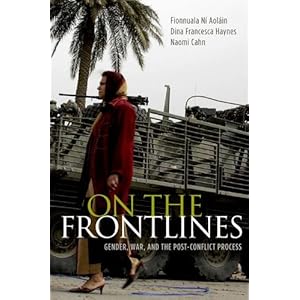
the authors' resistance to gender essentialism. Women's victim-status has dominated the post-conflict literature in ways that often reinforce gender essentialism. In some ways, this is understandable given the gendered nature of sexual harms suffered by women in areas of armed conflict. The analysis, however, must extend beyond victim-status to engage questions of women's participation in conflict and their involvement in the recovery effort. The authors' approach reinforces the complexity of women's experiences before, during, and after conflict.The rest of Bond's post is here. More on the book is here.
Tuesday, December 20, 2011
Available for Order at a Discount in the UK
UK readers (and others) can order War Time at a 25% discount from the Book Depository. They advertise free shipping worldwide, however they show an April release date, and the book should be available from US vendors in February.
Monday, December 12, 2011
"A Permanent State of Remote War"
William J. Astore, retired lieutenant colonel (USAF), has a post today on the remoteness of American wars from the American people:
The engagement of the people with a nation's wars has been central to ideas about warfare. War theorist Carl von Clausewitz wrote of the people as both an engine and a restraint on warfare. Clausewitz's "wonderful trinity," describes the nature of war as "composed of the original violence of its elements, hatred and animosity, which may be looked upon as blind instinct; of the play of probabilities and chance, which make it a free activity of the soul; and of the subordinate nature of a political instrument, by which it belongs purely to the reason." The trinity is often reduced to those Clausewitz thought to embody these elements: the people, the military, and the government.
The emotional element of war, centered in the people, can help motivate a nation to warfare. But the people can also rein in warfare. When the costs of war are too great, the people are thought to lose their will to fight, hampering the nation's ability to pursue war.
But what happens if the people are never in engaged in a war in the first place? This where Astore's point is so important. The remoteness of the American people from American wars, he argues, enables the nation's wars of choice. The absence of the people -- the embodiment of the emotional element Clausewitz thought was a central feature of warfare -- means that the people do not tire of the costs of war. The people's remoteness and isolation from war undermines their traditional role as a restraint.
Astore writes:
America’s wars are remote. They’re remote from us geographically, remote from us emotionally (unless you’re serving in the military or have a close relative or friend who serves), and remote from our major media outlets, which have given us no compelling narrative about them, except that they’re being fought by “America’s heroes” against foreign terrorists and evil-doers. They’re even being fought, in significant part, by remote control—by robotic drones “piloted” by ground-based operators from a secret network of bases located hundreds, if not thousands, of miles from the danger of the battlefield.Astore goes on to argue that wars of choice have led to "a state of permanent remote war" that "has weakened our military, drained our treasury, and eroded our rights and freedoms."
Their remoteness, which breeds detachment if not complacency at home, is no accident. Indeed, it’s a product of the fact that Afghanistan and Iraq were wars of choice, not wars of necessity. It’s a product of the fact that we’ve chosen to create a “warrior” or “war fighter” caste in this country, which we send with few concerns and fewer qualms to prosecute Washington’s foreign wars of choice.
The engagement of the people with a nation's wars has been central to ideas about warfare. War theorist Carl von Clausewitz wrote of the people as both an engine and a restraint on warfare. Clausewitz's "wonderful trinity," describes the nature of war as "composed of the original violence of its elements, hatred and animosity, which may be looked upon as blind instinct; of the play of probabilities and chance, which make it a free activity of the soul; and of the subordinate nature of a political instrument, by which it belongs purely to the reason." The trinity is often reduced to those Clausewitz thought to embody these elements: the people, the military, and the government.
The emotional element of war, centered in the people, can help motivate a nation to warfare. But the people can also rein in warfare. When the costs of war are too great, the people are thought to lose their will to fight, hampering the nation's ability to pursue war.
But what happens if the people are never in engaged in a war in the first place? This where Astore's point is so important. The remoteness of the American people from American wars, he argues, enables the nation's wars of choice. The absence of the people -- the embodiment of the emotional element Clausewitz thought was a central feature of warfare -- means that the people do not tire of the costs of war. The people's remoteness and isolation from war undermines their traditional role as a restraint.
Astore writes:
As Admiral Mike Mullen, former Chairman of the Joint Chiefs of Staff, put it recently to Time: “Long term, if the military drifts away from its people in this country, that is a catastrophic outcome we as a country can't tolerate.”One of the consequences of this development appears to be our current "permanent state of remote war."
Thursday, December 8, 2011
Endorsements and Availability
Oxford University Press has posted blurbs for War Time:
"For over a decade since 9/11, U.S. forces have been waging war. Yet is the nation itself 'at war'? In this timely and provocative book, Mary Dudziak shows why this question has become so difficult to answer-and warns of the dangers inherent in our failure to do so." --Andrew J . Bacevich , author of Washington Rules: America's Path to Permanent WarThe book will ship from OUP in January, and from other vendors in early February. Besides Amazon, it's listed at Powell's, Barnes and Noble, and Indie Bound.
"War Time turns our notions of both 'war' and 'time' upside down. This thought-provoking book forces us to realize that war is not an exception to 'normal' peacetime, but rather that wartime has become the norm. The implications of perpetual wartime are profound, for law, politics, and daily life. Mary Dudziak has again brought her keen cultural, historical and legal insights to bear on a subject of critical importance."--Elaine Tyler May, Regents Professor, University of Minnesota
"Taking law as her focal point but ranging much more widely, Mary Dudziak's provocative meditation on what we mean in speaking of a 'time' of war invites readers to reflect on how we think about war itself. It should change our understanding of what-and when-war 'is' for Americans."--Mark Tushnet, William Nelson Cromwell Professor of Law, Harvard Law School
"War Time is one of those rare books that can entirely reorient how one thinks about the world. By showing the reader what Americans have meant-and have come to mean-by 'wartime,' Mary Dudziak shows us assumptions about war and peace that govern political and legal thought without anyone noticing. This is an intellectual tour de force, and beautifully written to boot."--H. Jefferson Powell , George Washington Law School
Wednesday, December 7, 2011
Sunday, December 4, 2011
Roundtable: Pearl Harbor: 70 Years Later
The Society for Historians of American Foreign Relations has posted an excellent Roundtable for the seventieth anniversary of Pearl Harbor:
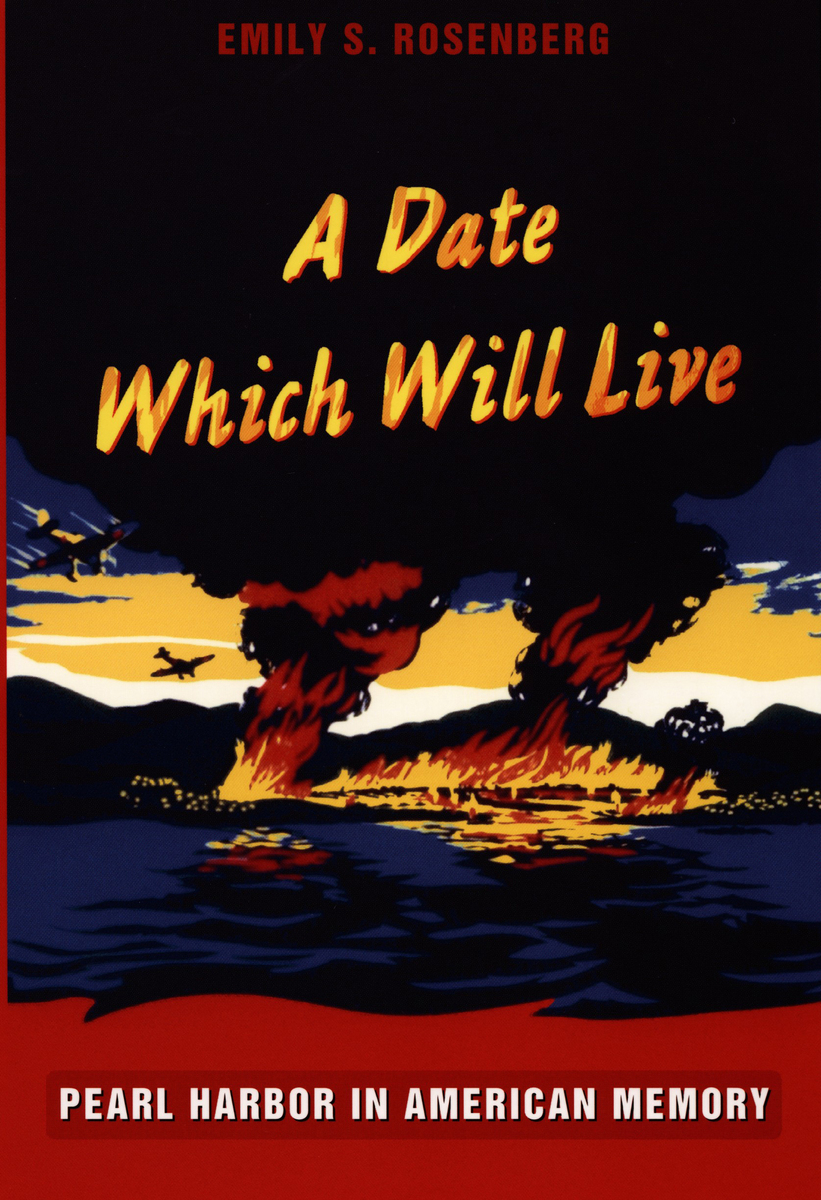
Emily Rosenberg, Forgetting Pearl Harbor
Greg Robinson, Pearl Harbor and Japanese Americans: Another Sort of Infamy
John Gripentrog, Pearl Harbor: The Road to Irreconcilable Worldviews
Yujin Yaguchi, Remembering Pearl Harbor in Hawai‘i: A Reflection on an Annual Workshop for U.S. and Japanese Secondary School Teachers
The entries are:Japan’s surprise attack of Pearl Harbor on December 7, 1941 was a dramatic event that resulted in the destruction and decapitation of eighteen U.S. vessels and 188 planes, as well as the death of over 2,400 Americans. The experience was spectacular and horrifying. Yet the impact of the military operation far transcended the immediate damages it inflicted on the strategically valued harbor. Throughout the years afterwards, the “day of infamy” would yield far-reaching influence on politics, diplomacy, society, and culture in the United States, Japan, Hawai’i, and other parts of the world.
SHAFR.org is proud to present a roundtable on the Pearl Harbor attack as we approach its seventieth anniversary. We have asked four historians—Emily S. Rosenberg, Greg Robinson, John Gripentrog, and Yujin Yaguchi—to reflect on this fateful experience and address its broader significance. The contributors offer insight on a wide range of issues, concerning politics, diplomacy, memory, popular culture, racism, and education. We hope this forum will aid readers in grasping the complexity of this important event.
Emily Rosenberg, Forgetting Pearl Harbor
Greg Robinson, Pearl Harbor and Japanese Americans: Another Sort of Infamy
John Gripentrog, Pearl Harbor: The Road to Irreconcilable Worldviews
Yujin Yaguchi, Remembering Pearl Harbor in Hawai‘i: A Reflection on an Annual Workshop for U.S. and Japanese Secondary School Teachers
Saturday, December 3, 2011
Thursday, December 1, 2011
Kuzmarov on Militarized Policing
Jeremy Kuzmarov, University of Tulsa, has an interesting post on History News Network.
Kuzmarov is the author of "The Myth of the Addicted Army: Vietnam and the Modern War on Drugs" (Amherst, MA: University of Massachusetts Press, 2009) and the forthcoming, "Modernizing Repression: Police Training and Nation Building in the American Century" (Massachusetts).
The images of militarized police units organized in platoon formation pepper spraying and beating peaceful demonstrators at UC Davis and at the Occupy encampments across the country have been disturbing to witness, though they provide a potent symbol of the times. While staffed with people from working-class backgrounds, the police in American society have long served as “protectors of privilege,” as Frank Donner put it in a 1990 book, upholding the power of the wealthy 1% by frequently crushing labor protest, spying on and harassing civil rights and antiwar activists, and enforcing the War on Drugs primarily in ghetto communities.
As much as racial profiling and brutality have been deeply rooted in the history of American police institutions, so has their militarization, owing in part to the influence of overseas police training programs.Read the rest here.
Kuzmarov is the author of "The Myth of the Addicted Army: Vietnam and the Modern War on Drugs" (Amherst, MA: University of Massachusetts Press, 2009) and the forthcoming, "Modernizing Repression: Police Training and Nation Building in the American Century" (Massachusetts).
Friday, November 25, 2011
A Growing 'Civilian-Military' Gap, and its Consequences
"A smaller share of Americans currently serve in the U.S. Armed Forces than at any time since the peace-time era between World Wars I and II," according to a new report from the Pew Research Center (hat tip New York Times).
Military service is now more concentrated in certain families: "Veterans are more than twice as likely as members of the general public to say they have a son or daughter who has served (21% vs. 9%)." And overall, what the report calls a "military-civilian gap" is more pronounced among younger people.
Legal scholars argue here and elsewhere that the tendency of presidents to initiate military action without congressional authorization can only be reined in if Congress insists on playing its constitutional role. But Congress will never play a more meaningful role in American war politics if the people aren't engaged. The Pew Report helps us to see what appears to be a growing distance from the costs of war, potentially reinforcing contemporary political disengagement.
In War Time, I take up this point in the Conclusion:
As Americans become more isolated from the costs of war, military engagement no longer seems to require the support of the American people. Their disengagement does not limit the reach of American military action, but enables its expansion.
During the past decade, as the military has been engaged in the longest period of sustained conflict in the nation’s history, just one-half of one percent of American adults has served on active duty at any given time.1 As the size of the military shrinks, the connections between military personnel and the broader civilian population appear to be growing more distant.The data reveals is "a large generation gap." According to the report, "more than three-quarters (77%) of adults ages 50 and older said they had an immediate family member –a spouse, parent, sibling or child – who had served in the military." In contrast, for people under 50, "57% of those ages 30-49 say they have an immediate family member who served. And among those ages 18-29, the share is only one-third."
Military service is now more concentrated in certain families: "Veterans are more than twice as likely as members of the general public to say they have a son or daughter who has served (21% vs. 9%)." And overall, what the report calls a "military-civilian gap" is more pronounced among younger people.
This suggests that the gap between veterans and the general public in the share that has family connections to the military may be a relatively new phenomenon. With the shrinking size of the military in recent decades there are now fewer connections between the military and the civilian world. This is reflected in the relatively small share of young adults (39%) with an immediate family member who has served in the armed forces.The Pew report suggests that various political opinions are correlated with connections to family members who have served in the military, but there are deeper implications of the disconnect between Americans and American war-making. The more distant and isolated Americans are from their nation's wars, the less they are politically engaged with American war policy.
Legal scholars argue here and elsewhere that the tendency of presidents to initiate military action without congressional authorization can only be reined in if Congress insists on playing its constitutional role. But Congress will never play a more meaningful role in American war politics if the people aren't engaged. The Pew Report helps us to see what appears to be a growing distance from the costs of war, potentially reinforcing contemporary political disengagement.
In War Time, I take up this point in the Conclusion:
In Iraq and Afghanistan, war...spread across borders as American drones fired on targets in Pakistan and elsewhere. Death and destruction were the province of soldiers and of peoples in faraway lands. The experience of wartime for most Americans largely devolved to encounters between travelers and airport screeners, as the Transportation Security Administration adopted intrusive new practices. At home, wartime had become a policy rather than a state of existence....I argue that keeping the war powers in check requires a politics of war, and that requires a citizenry attentive to the exercise of military power. Our ideas about "wartime" play a role in the current disconnect, as a cultural framing of wartimes as discrete and temporary occasions, destined to give way to a state of normality, undermines democratic vigilance over on-going wars.
As war goes on, Americans have lapsed into a new kind of peacetime. It is not a time without war, but instead a time in which war does not bother everyday Americans.
As Americans become more isolated from the costs of war, military engagement no longer seems to require the support of the American people. Their disengagement does not limit the reach of American military action, but enables its expansion.
Monday, November 21, 2011
'The Martial Spirit' in American History: John Hope Franklin on Militarization and War
 On November 28, I'm delivering a lecture at Duke Law School. As the John Hope Franklin Chair while a visitor at Duke this fall, my initial plan was to simply draw a connection between Franklin's work and new scholarship on African Americans and war, as well as my new work on the nature of wartime. But the more I read, the more I came to believe that engaging Franklin's work requires a rethinking of the history of American militarization. And that became the lecture. Here's the announcement:
On Nov. 28, legal historian Mary L. Dudziak will deliver Duke University’s Robert R. Wilson lecture titled “The ‘Martial Spirit’ in American History: John Hope Franklin on Militarization and War.” Her lecture will draw both from Franklin’s work and from recent historical scholarship on African Americans and war to place African American history at the center of American militarization.
The lecture will begin at 12:30 p.m. in room 3041 of Duke Law School, located at 210 Science Drive on Duke University’s West Campus. Parking is available at the Bryan Center. A light lunch will be served on a first-come first-served basis.More details are here.
The role of militaries in enabling or undermining democracy has been on display in 2011 during the Arab Spring. In American history as well, said Dudziak, military conflict has played an important role in shaping domestic politics and culture. “African American history is often seen as peripheral to the history of war and militarization, but Franklin placed it at the center,” she said. “From one of his early books, initially titled The Martial Spirit, which detailed the growth of militias to guard against slave insurrection, to the dynamic impact of war in his sweeping survey, From Slavery to Freedom, Franklin shows us that African American history and the history of American war and militarization were intertwined, from the slave patrols, to the race discrimination in the World War II military that scarred his own family, to the military as a workplace for contemporary people of color.”
Monday, November 14, 2011
First Review
Just in from Publisher's Weekly:
Dudziak (Exporting American Dreams) riffs on the meaning of wartime and its legal implications in this brief cultural history. She examines the meaning of wartime in American history and notes that “an essential aspect of wartime is that it is temporary.” Because war is seen as provisional, Americans have been willing to accept “exceptional [wartime] policies” that enhance presidential power and erode civil liberties—a view generally endorsed by the courts. What if, Dudziak asks, “American war spills beyond tidy time boundaries” and wartime becomes “normal time”? The executive branch, she contends, has defined the war on terror along the lines of the cold war, as an ideological conflict with no boundaries. Dudziak laments that the courts generally have continued to treat wartime as temporary even though its meaning has changed. Wartime, she concludes, has “become a policy, rather than a state of existence” and need not cause us to suspend our principles. Closely argued and clearly written, this is a scholarly work with popular appeal. (Feb.)
Monday, October 10, 2011
Webcast: Ben C. Green Lecture, Case Western Reserve University Law School
Sunday, October 9, 2011
Why do we think war is temporary, when war doesn’t come to an end?
Lecture at Oberlin College, Monday, October 10, 4:30 p.m. King Hall, Room 337.
Saturday, October 1, 2011
"Rumors of War" -- Justice Jackson after Nuremberg
This event at the University at Buffalo, Tuesday, October 4, commemorates the first public address Justice Robert Jackson gave after returning from his work as Chief Prosecutor at the Nuremberg trial. I will take up the way Jackson understood law and security in the context of a changing world in the years after Nuremberg, as the categories of war and peace lost their distinction, leaving ongoing tensions and, as Jackson put it, "rumors of war." Jackson biographer John Q. Barrett, and legal historian Eric Muller will also speak.
The 2011 edition of the James McCormick Mitchell Lecture, the UB Law School’s highest-profile lecture series, revisits a significant historical moment for UB and the world—one that has been largely overlooked.
The lecture, to begin at 2 p.m. Oct. 4 in 106 O’Brian Hall, North Campus, will examine a major address by U.S. Supreme Court Justice Robert H. Jackson given at the University of Buffalo’s centennial celebration exactly 65 years ago. Jackson, who had taken a leave of absence from the high court to serve as the chief U.S. prosecutor at the Nuremberg war crimes trial in occupied Germany that followed the Nazis’ surrender in World War II, spoke at UB immediately after he returned from that historic trial in 1946.
His speech touched on timeless themes: how a “warlike spirit” can overcome a nation; the quest for nations to work cooperatively in the cause of peace; the interrelationship of war and dictatorship; and the supremacy of law over the lawless forces of war and persecution.
The 2011 Mitchell lecture will feature three legal scholars who will discuss aspects of Jackson’s 1946 address, placing the speech in historical context and discussing its enduring implications. Mitchell lecturers will be:
The event will mark another anniversary as well: the 60th year of the Mitchell lecture series, whose first installment in 1951 also featured Jackson speaking on “Wartime Security and Liberty Under Law.”
- John Q. Barrett, professor of law at St. John’s University in New York City and a board member at the Robert H. Jackson Center in Jamestown, N.Y., who will discuss “Bringing Nuremberg Home: Justice Jackson’s Path Back to Buffalo, Oct. 4, 1946.” Barrett is writing a biography of Jackson.
- Eric L. Muller, professor at the University of North Carolina School of Law and a legal historian with special interest in the Japanese internment cases during the World War II era, who will discuss “Nazis, Americans and the Law as a ‘Peace Profession.’”
- Mary L. Dudziak, Judge Edward J. and Ruey L. Guirado Professor of Law, History and Political Science at the University of Southern California, who will speak on “Rumors of War.”
Sunday, September 18, 2011
The Legal Landscape Ten Years After 9/11
This recent panel at Duke Law School features Duke Professors Curtis Bradley, Charles Dunlap and Neil Siegel, and me.
Monday, September 5, 2011
When we say that 9/11 changed something, what are we saying?
We are beginning a week of reflection on the events of September 11, 2001. Some 10th anniversary events will be memorials, remembering those who perished that day. Other events will seek to make sense of what 9/11 did – to New York, to the United States, to the world. So often remembered as a day that “changed everything,” academic panels will be held and op-eds written about just what 9/11 changed, and what it didn’t.
But what does it mean to say that 9/11 changed something? There is often a slipperiness in the causality. It is sometimes assumed that the terrorist attacks set certain historical events into motion. But if we see 9/11 as causing the politics, culture and military actions that followed, then we are giving the airplanes that slammed into buildings a powerful determinism. We are assuming that al Qaeda did not just slaughter thousands, but drove American politics for the next decade.
The post-9/11 era has sometimes been compared with the Cold War era to understand the way security concerns can impact rights. The Cold War era shares another feature with the post-9/11 years: a murkiness about causality. Although library shelves are filled with studies about what the Cold War did, just how the Cold War acted in history is sometimes left to the imagination. The Cold War is sometimes evoked as if it were a climate system – as in the “Cold War climate,” but this climate somehow nebulously drove politics and culture. Sometimes the Cold War is treated like a “hot” war, but without attention to its different military characteristics. Sometimes it is simply a time-span, but nevertheless retains its causal character.
Diplomatic historians devote themselves to running down the details and understanding how the domestic and global puzzle pieces fit together. But legal scholars often employ the Cold War as a category without this precision.
Similarly, 9/11 is seen as setting into play a series of events, without attention to whether we need a causal stopping point. This builds in an assumption that there was a direct and inevitable line from the terrorist attacks to the Global War on Terror, and to the way American domestic and military policies were formulated. This accords Osama bin Laden more power that he actually had.
The assumption that 9/11 directly caused post-9/11 American policy also obscures one of the experiences of September 11 itself: the profound confusion. When the second plane hit the South Tower of the World Trade Center, the terrible shock was coupled with fear and anxiety, and the question of what on earth was going on. President George W. Bush provided an answer: the nation was at war. The wartime frame provided the president with a powerful way to rally the nation. Americans came to see 9/11 as the opening of a wartime, but this displaced competing arguments at the time about what 9/11 was, and how the nation should respond.
On this 10th anniversary, we should see 9/11 as a crisis that enabled a political moment. In the face of this crisis, American leaders made choices. The most important choice of all was how to frame the terrorist attacks – to call the crisis a war.
Al Qaeda succeeded in a devastating attack on September 11. What the terrorists did not and could not do was to determine American policy and politics for the next decade. Even if 9/11 changed the way Americans thought about the world, it could not determine the actions we would take in its aftermath. It did not deprive American leaders of choices.
Cross-posted from Balkinization.
But what does it mean to say that 9/11 changed something? There is often a slipperiness in the causality. It is sometimes assumed that the terrorist attacks set certain historical events into motion. But if we see 9/11 as causing the politics, culture and military actions that followed, then we are giving the airplanes that slammed into buildings a powerful determinism. We are assuming that al Qaeda did not just slaughter thousands, but drove American politics for the next decade.
The post-9/11 era has sometimes been compared with the Cold War era to understand the way security concerns can impact rights. The Cold War era shares another feature with the post-9/11 years: a murkiness about causality. Although library shelves are filled with studies about what the Cold War did, just how the Cold War acted in history is sometimes left to the imagination. The Cold War is sometimes evoked as if it were a climate system – as in the “Cold War climate,” but this climate somehow nebulously drove politics and culture. Sometimes the Cold War is treated like a “hot” war, but without attention to its different military characteristics. Sometimes it is simply a time-span, but nevertheless retains its causal character.
Diplomatic historians devote themselves to running down the details and understanding how the domestic and global puzzle pieces fit together. But legal scholars often employ the Cold War as a category without this precision.
Similarly, 9/11 is seen as setting into play a series of events, without attention to whether we need a causal stopping point. This builds in an assumption that there was a direct and inevitable line from the terrorist attacks to the Global War on Terror, and to the way American domestic and military policies were formulated. This accords Osama bin Laden more power that he actually had.
The assumption that 9/11 directly caused post-9/11 American policy also obscures one of the experiences of September 11 itself: the profound confusion. When the second plane hit the South Tower of the World Trade Center, the terrible shock was coupled with fear and anxiety, and the question of what on earth was going on. President George W. Bush provided an answer: the nation was at war. The wartime frame provided the president with a powerful way to rally the nation. Americans came to see 9/11 as the opening of a wartime, but this displaced competing arguments at the time about what 9/11 was, and how the nation should respond.
On this 10th anniversary, we should see 9/11 as a crisis that enabled a political moment. In the face of this crisis, American leaders made choices. The most important choice of all was how to frame the terrorist attacks – to call the crisis a war.
Al Qaeda succeeded in a devastating attack on September 11. What the terrorists did not and could not do was to determine American policy and politics for the next decade. Even if 9/11 changed the way Americans thought about the world, it could not determine the actions we would take in its aftermath. It did not deprive American leaders of choices.
Cross-posted from Balkinization.
Wednesday, August 17, 2011
Exporting American Dreams -- Out in Paperback
My book Exporting American Dreams: Thurgood Marshall's African Journey, has just been released in a new paperback edition, with a new afterword, by Princeton University Press. Here's the book description:
And excerpts from a couple of reviews:Mary Dudziak's Exporting American Dreams tells the little-known story of Thurgood Marshall's work with Kenyan leaders as they fought with the British for independence in the early 1960s. Not long after he led the legal team in Brown v. Board of Education, Marshall aided Kenya's constitutional negotiations, as adversaries battled over rights and land--not with weapons, but with legal arguments. Set in the context of Marshall's civil rights work in the United States, this transnational history sheds light on legal reform and social change in the midst of violent upheavals in Africa and America. While the struggle for rights on both continents played out on a global stage, it was a deeply personal journey for Marshall. Even as his belief in the equalizing power of law was challenged during his career as a Supreme Court justice, and in Kenya the new government sacrificed the rights he cherished, Kenya's founding moment remained for him a time and place when all things had seemed possible.

[A] work for the ages. Dudziak's Exporting American Dreams creatively juxtaposes the African American struggle for equality in law with the Kenyan struggle for political independence from white British colonial rule. . . . Dudziak casts Marshall as a bridge between two epochal quests for human dignity, drawing painful parallels. -- Makau Mutua, Human Rights Quarterly
[A] thought provoking and painstakingly researched journey through a crucial transformational moment in two nations' histories. . . . [W]e are invited to reflect on the potentials and core limits on liberalism, democracy, and law as paths to transformation and justice. -- Julie Novkov, Law and Politics Book Review
Subscribe to:
Posts (Atom)